
 English
 Chinese (Simplified)
 Indonesian
 Japanese
HDPE PIPE RING STIFFNESS


General preface to importance of stiffness
The measurement of Pipe-stiffness is described in different national and international standards. The Ring-Stiffness of Pipes is one of the important indicators for the evaluation of Pipe stability.
But Ring-stiffness should not be overvalued, always it has to be considered that the results are measured under Laboratory-conditions. The flexible behaviour of thermoplastic pipes is requested and it’s one of the reasons for the positive experience we made worldwide with thermoplastic pipes in the last 50 years.
It is important that pipes provide enough stiffness to avoid higher deformation than permitted and that the wall structure provides enough structural stability to avoid local buckling. Thermoplastic pipes have the capability to avoid or at least to reduce stress concentrations due their flexibility. The creep-behaviour under load is characteristic for thermoplastics and is very helpful to control the deflection-process, due the relaxation of stress-loaded areas.
Mostly the static designs are following international standards like AWWA M55 or the German DWA A 127, but in any case the procedure always considers the flexible behaviour of pipes and working with limits for maximal deformation (e.g. DWA A 127 : 6 %).
The long-term experience shows clearly that the static calculations provide very realistic results and the pipe-deformation is lower than the calculated limit. The standards for Ring stiffness-Tests are concentrating on a deformation range of 3%, but also bigger larger deformations can be tested.
Standard Ring Stiffness Test Procedures
Mainly we differ two different procedures to measure and evaluate the pipe-stiffness:
- Testing under constant load
acc. DIN 16961-2: Thermoplastic pipes with profiled wall and smooth pipe inside
- Testing under constant speed
acc. DIN EN ISO 9969: Thermoplastic Pipes-determination of Ring stiffness
At noth procedures a cut length of pipe (typically up to 1 m long) is being horizontal supported and compressed vertically between two parallel flat plates.
Constant load
Testing under constant load goes back to the early standard of DIN 16961, where the procedure until now is standardized. Typically the Test takes 24 hours and a 24h value for stiffness is defined = SR24 but also long-term tests up to 2000 or 10000 hours are applicable.
The steeps of the test procedure can be summarized as follows:
- Geometical analysis of the used wall structure
- Calculating the theoretical pipe stiffness under consideration of results for geometrical analyses and Ec modulus for the expected testing-time
- Calculation the test-load (weight) under consideration of chosen theoretical deflection (typical 3%)
- Beginning Test by loading the pipe crown with calculated weight
- Measuring deflection during testing time
- Result for deflection has to be equal or lower than theoretical deflection
Constant speed
Testing under constant speed is standardized in DIN EN ISO 9969 and it is mainly a short-term test.
The ring stiffness is determined by measuring the force and the deflection while deflecting the pipe at a constant deflection speed. The ring stiffness is calculated as a function of the force necessary to produce a 3% diametric deflection of the pipe.
The deflection speed depends on the nominal diameter of the pipe, for large diameters, nominal diameter >710 mm the speed is specified with as 0,03 x Inner diameter (mm/min) a tolerance of +- 5%
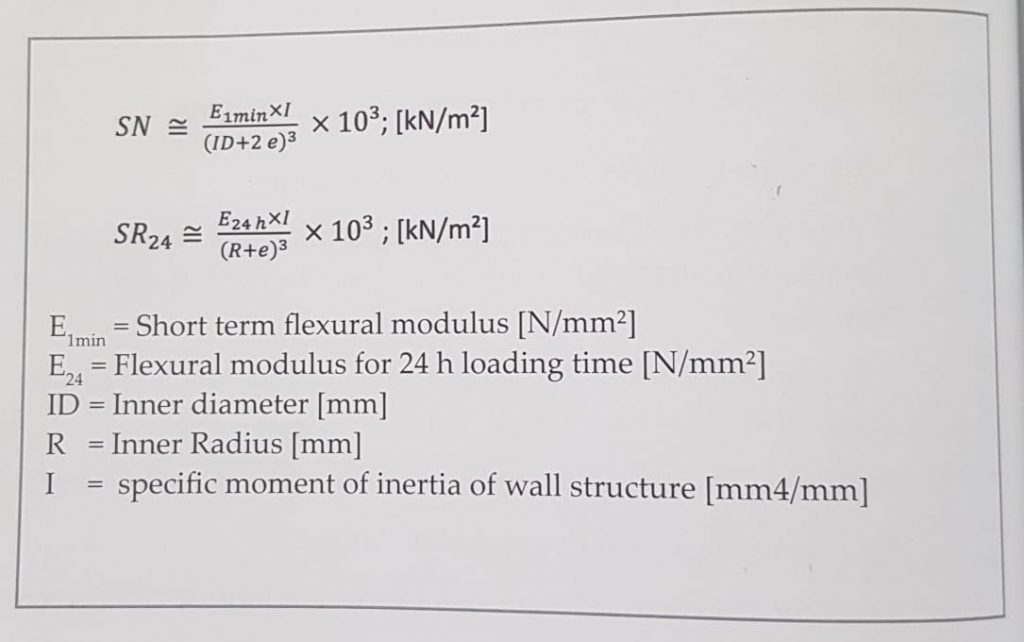
Typically the stiffness is categorized in classes according to the mentioned standards, SN classes = SN 2; SN4; SN8; SN16, but intermediate stiffness values are also often used for technical description: e.g. S = 7 kN/m²
Roughly the stiffness can be calculated theoretically for both procedures so far as the creep modulus E is know and also the geometrical data for moment of inertia and distance of gravity is determined.

article source:
Handbook on large plastic pipe

