
 English
 Chinese (Simplified)
 Indonesian
 Japanese
Geopipe


Before knowing what a geopipe or geosynthetic pipeline is, it helps us to know the types of geosynthetics and their understanding, from several articles on the internet or Google or also on Wikipedia. I summarize some of them as follows:
Geosynthetic Types and their Definition
Geosynthetic is a type of synthetic material / synthetic material used to improve soil and road construction that has unstable soil and surface contours. There are many types of geosynthetics that are often used for making road layers and soil which are often used for road construction.
Geosynthetic Types and Definition:
1. Geobag is geotextile that is filled with soil and sewn so that it forms padding which is used to replace conventional coastal protection rocks / buildings.
2. Geocomposite is a composite material made from non woven geotextile base material with woven high-strength 2-way polyester yarn. Thus we get two functions at once namely strengthening and separation as well as the filtration function.
3. Geogrid is a type of Geosynthetic material (Geosynthetic) which has a large enough opening, and body stiffness that is better than Geotextile. Geogrid basic materials can be: Polyphropylene, Polyethilene and Polyesther or other polymer materials.
4. Geomembrane is plastic sheet made from HDPE / LLDPE / PVC, etc. This sheet is made using sophisticated and modern machinery so that its specific gravity and thickness are maintained. Geomembrane has characteristics that are impermeable to liquids.
5. Geopipe is a perforated or solid polymer pipe that is used to drain liquids, gases and includes leachates or gas collectors in landfill applications.
6. Geotextile is one of the translucent Geosynthetics (Geosynthetic) materials, which can be used / functions as a separator, filter, protection, and reinforcement. The basic ingredients are Polyesther or Polyprophilene. Generally divided into two types: Non Woven and Woven.
The use of geosynthetics or synthetic materials is related to the durability of synthetic materials in chemical compounds, weathering, wear, ultraviolet light and microorganisms. The most important polymers that are used for geosynthetic manufacturing are Polyester (PET), Polyamide (PM), Polypropylene (PP), and Polyethylene (PE).
Article source:
from the author: Samsul Arifin
Article title: Geosynthetic Types and Definition
academia.edu
Related to the products manufactured by PT. Shuanglin Pipe Indonesia namely geosynthetic pipe or goepipe. Here is information about what is a goepipe or geosynthetic pipe.
What is Geopipe?
Geopipe Corrugated Perforated atau Non Perforated merupakan pipa HDPE bergelombang dan berlubang atau tidak berlubang yang digunakan sebagai “subdrain system” pada lapangan sepak bola, lapangan golf, taman dll atau sebagai pipa saluran pembuangan atau selongsong pipa kabel bawah tanah.
Geopipe didesain agar dapat menahan beban tekanan lebih baik dibandingkan pipa jenis biasa, memiliki panjang hingga 50 meter dengan berat yang ringan sehingga memudahkan dalam proses mobilisasi di lapangan.
Tipe Geopipe terdapat 2 jenis yaitu single wall dengan bagian luar dan dalamnya bergelombang dan double wall dengan bagian dalamnya mempunyai lapisan tambahan.
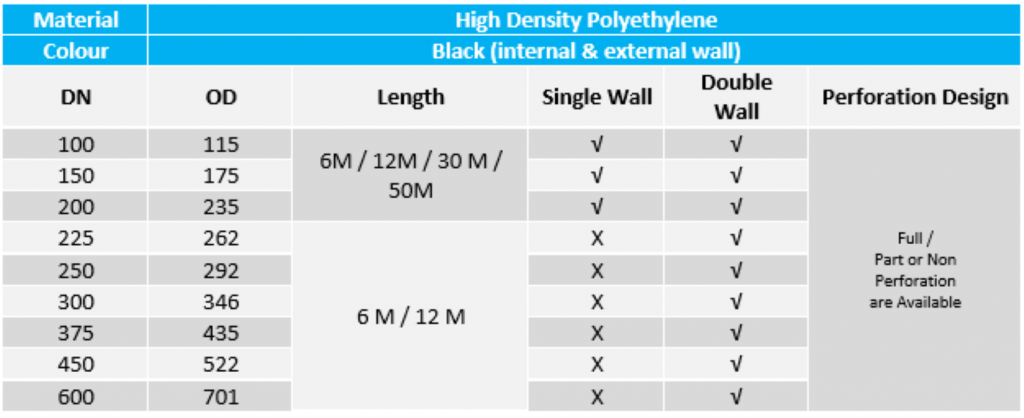
DN : Nominal Diameter/br>
OD : Outside Diameter
*All unit measurement base on (mm)
Geopipe is all plastic pipes used in soil, rock, or other subsurface materials as an integrated part of a project, structure or system.
Benefits:
- Quick Installation
- Having strength at good pressure
- Easy handling
- Efficient drainage
- Flexible
- Corrosion resistant
- Large drainage capacity
Application:
- Subsurface drainage in road construction
- Drainage in residential and commercial construction
- Drainage at the mine
- Agricultural land
- Building foundation
- Retaining wall application
- Construction land
- Sports field and recreation area

