by

Buried Flexible Pipes Behaviour In Unreinforced And Reinforced Soils Under Cyclic Loading

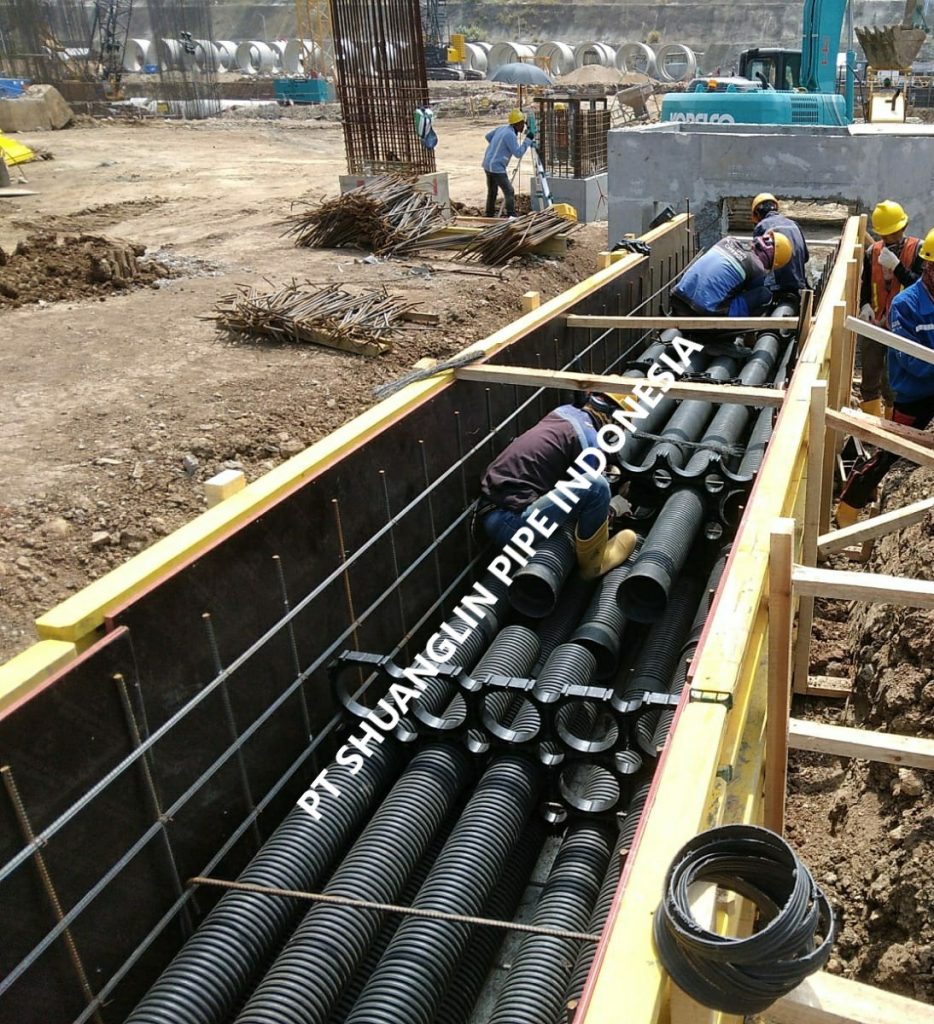
In this research, large-scale fully instrumented laboratory tests were conducted to investigate the behaviour of flexible high-density polyethylene (HDPE) pipes, in unreinforced and geogrid-reinforced sand, subjected to incrementally increasing cyclic loading; for example, due to different vehicle capacities or load increase with passing time. Results illustrated that the deformation rate in the pipe and footing, the strain generation rate in the pipe and reinforcing layers are rapidly increased in the initial loading cycles, in particular during the first 300 cycles, and then the rate of change decreases significantly as more cycles are applied. In the unreinforced case, increasing the pipe burial depth significantly reduced the generated deformation and strain in the pipe; however, it has a situational effect on the footing settlement, where it increased after pipe burial depth to its diameter ratio (H/D) of 2.5. In reinforced cases, deformation and strain significantly reduced with the increase in pipe burial depth and number of reinforcing layers. Measurement of strain illustrated that strain generated in the lower reinforcing layer is always higher than that recorded in the upper one, regardless of pipe burial depth and value of applied load.

Article resource : https://www.icevirtuallibrary.com/doi/full/10.1680/jgein.18.00046
Upload by : Evi, PT Shuanglin Pipe Indonesia

by

Large pressure pipe system – Fully PE100

Sverre Tragethon, Martin Andersson

Papers # 2018 Las-Vegas

Global mega trends push for investments in sewage treatment capacity & efficiency. A trend is to go for central regional treatment sites, typically remotely located from dense populated cities. This calls for high capacity pressure sewage transmission pipelines. Reliable operation is of course of paramount importance for the circular urban society. Sweden’s currently biggest infrastructure project is a green field project for new regional sewage treatment centre and transmission pipeline. Initially project faced a challenge; how to combine big diameter pipeline with varying topographic and ground conditions, on tight budget? GRP was first considered, but was dropped in favour of PE100.

PE100 flexibility and weldability made the difference. Notable is that also selection of ancillary equipment typically produced from stainless steel etc, were here replaced with components machines out from PE100 sheets and finally welded. This concept was enabled by involving an extended team of expertise. Altogether this new smart concept made the final choice easy for the project team.

Two parallel 1000mm SDR17 PE100 pipelines, >500 welds, PE100 based flanges electrofusion couplers, degassers, etc. All PE100 and 100% welded

Key learning; Key learning; success calls for co-operation between different providers. PE100 proved being the choice for big diameter piping and tailored solutions.

Article source : https://www.pe100plus.com/PPCA/Large-pressure-pipe-system-Fully-PE100-p1700.html
Upload by: Evi, PT Shuanglin Pipe Indonesia

by

WHY CHOOSE HDPE CORRUGATED PIPE

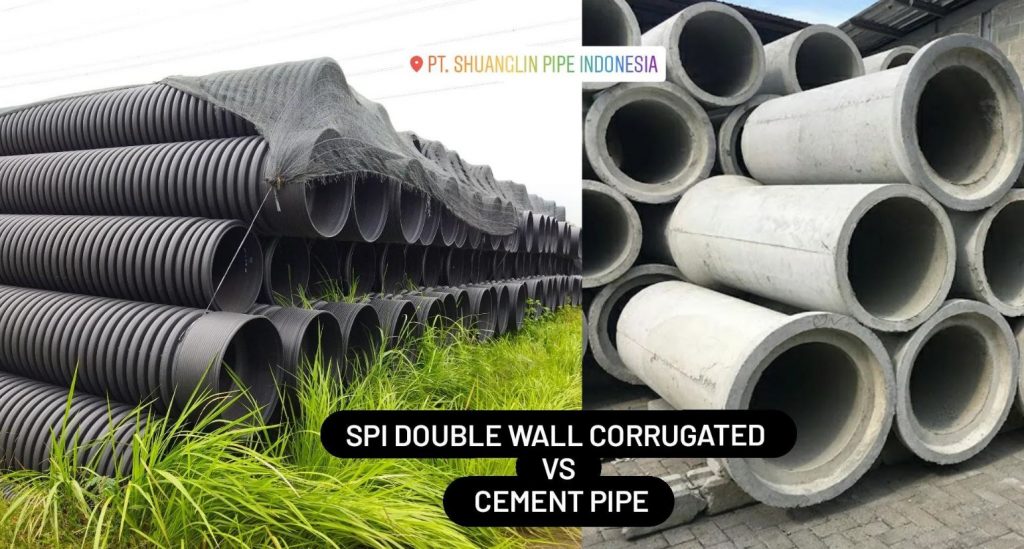
“Flexible” pipes (made of PE, PP, PVC and HDPE) are able to satisfy all the initial project needs in a more efficient manner due to the thermoplastic material characteristics. These characteristics can easily solve general work site problems because they are durable, chemically resistant and last but not least, easy to handle. The “rigid” ones instead (made of concrete, iron and stoneware) can offer a good static performance but they lose in durability, chemical resistance and being heavy demand more manipulation thus increasing installation costs.

The main differences that can be noted between HDPE pipes and those built in concrete are:
1. BUILDING TECHNOLOGIES
For the production of concrete pipes, rustic mold are used, vibrated or spun; while HDPE corrugated pipes production is made with highly technological machinery, using also sophisticated control system, able to manufacture pipes in different lengths requested by the customer

2. PHYSICAL CHEMICAL CHARACTERISTICS
The concrete pipes are extremely heavy. They have a good axial resistance but a poor traction resistance. Let’s consider also a durability lower than 50% with respect to a normal corrugated HDPE conduit that is also lighter and present an excellent impact resistance. HDPE offers also an elevated resistance against aggressive chemicals. Life durability of the HDPE pipes is estimated in periods superior to 50 years

3. HYDRAULIC CALCULATIONS
HDPE presents a wall abrasion notably reduced in comparison with the concrete pipe.
This characteristic consents:
Increase of the fluids velocity inside the pipe, maintaining the same pipe capacity
Less risk of sedimentation and minor frequency of maintenance
Lower interior diameter needed, since the maximum capacity of the project can be satisfied with a lower conduit capacity: this leads to lower costs and reduced time of realization of the project
Environmentally friendly impact.

Example 1
Drainage pipeline construction which satisfies maximumj capacity (Qmax) equal to 1350 l/sec.
tab. 1


Example 2
Drainage pipeline construction which satisfies maximum capacity (Qmax) equal to 1295 l/sec.
tab. 2



The capacity of the system designed with concrete pipe parameters can be equally satisfied with HDPE corrugated pipes of equal diameters.
1. CHEMICAL CORROSION RESISTANCE and ABRASION RESISTANCE
Concrete conduits can be taken into consideration when the waters are clear. They are less indicated for industrial wastewater, while HDPE chemical resistance, in relation to the major corrosive chemical composites, can be defined as excellent. Concrete is generally “hard” and therefore “fragile”: there are test results that prove the concrete pipe lasts shorter time, therefore the material has a reduced abrasion resistance. On the other hand, HDPE pipes, thanks to the low elasticity module and the reduced roughness, have an elevated abrasion resistance.
2. MOVEMENT AND LAYING
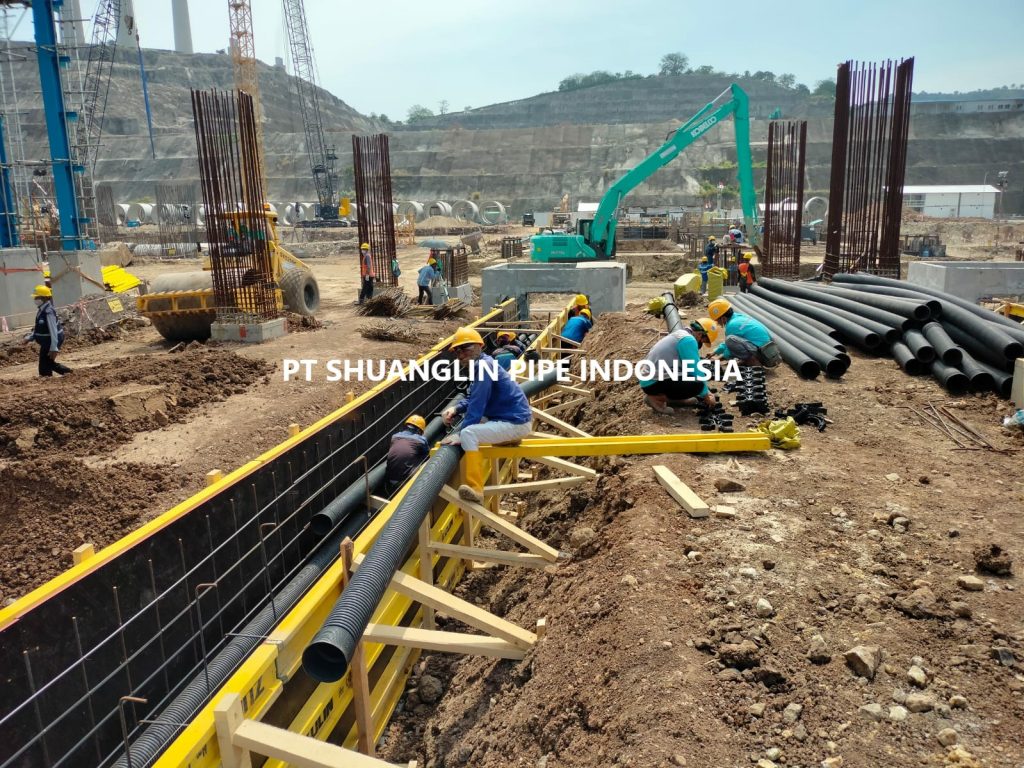
From the weights on table tab. 3 you can clearly see that it is necessary to utilize bigger and more powerful tools which are therefore more costly. The major length of the HDPE pipes guarantee a speedier laying together with an higher work-site productivity.
tab. 3

Weighted average: concrete+ 1065% per bar (≡ 3396% al m)
The major length of the bars, reduces also the number of junctions (6 times inferiors), with a significant reduction of critical points and therefore reduced costs for the safety.
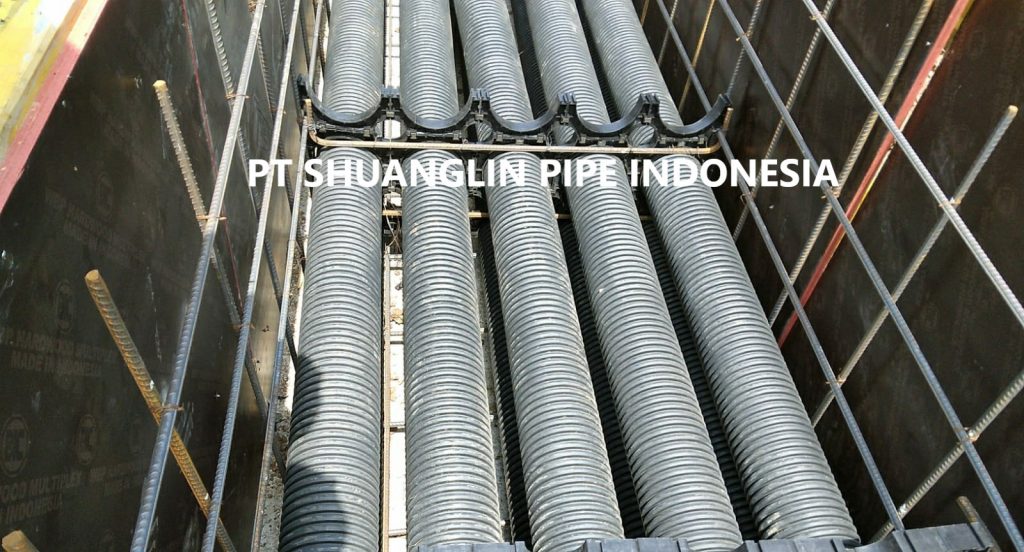
For HDPE corrugated pipes, the preparation of an adequate trench bed is necessary: the pipes should have an adequate isolation against those materials, which could cause stress.
The flexible pipes are highly adaptable to terrain movements, and they easily support earth movements without interrupting the flow.

In the end why choose the HDPE?
To optimize the entire network, it is necessary to have high performances in the operability of the entire system.
The choice must not only be concentrated on the material, but also on the entire system. Overall, if we consider the single element, a network composed of concrete material offers a minor cost with respect to the HDPE corrugated pipe; but in reality, it is necessary to consider the minor efficiency in whole system due to:
1. Minor chemical and biological resistance of the concrete product
2. Less adaptability to the soil movements
3. Minor durability
4. Less hydraulic efficiency
5. Major maintenance

Therefore, a modern network made by polyethylene elements (pipes, fittings, special pieces and manholes) has an added value which has no equals, especially considering the total costs in addition to high safety and evironmentally friendly.

Article source: https://tubi.net/en/differences-between-hdpe-corrugated-and-concrete-pipes/ 
Edit, and upload by : Evi, PT Shuanglin Pipe Indonesia


by

PE100+ Association underlines the importance of using pre-compounded black PE100 resins across Asia

The PE100+ Association continued to grow its presence across Asia by participating in several industry events in the first half of 2019, representing the commitment of the association and all its members to promote the use of high quality pre-compounded PE100 resins as the only solution for the production of plastic pressure water pipes.

The first Asian event of 2019 to feature the PE100+ Association was the Water Philippines Exhibition, held in March 20-22 in Manila. The PE100+ Association, represented by members from Borouge and Siam Cement Group (SCG), participated at this major industry event with a booth and a presentation. The paper, entitled “The benefits of pre-compounded polyethylene for water pipe systems” and given by Borouge, highlighted the growing concerns of water scarcity and underlined the importance of material excellence, in particular the need to use pre-compounded Black PE100 materials in order to guarantee pipe performance and ultimately reduce water losses by ensuring leak-free and secure pipelines.

In the same month, the PE100+ Association took part in the China Water Pressure PE Pipe GB13663 National Standard Conference in Wuhan. China has updated its GB13663 standard to promote the use of pre-compounded PE100 resins for water pipelines and has tightened testing requirements in order to achieve better quality control. This highlights the intention of the Chinese national standards committee and the water pipe industry to establish the approach of using pre-compounded PE100 resin in order to guarantee quality.  PetroChina represented the PE100+ Association in support of the updated GB13663 standard by presenting a paper that highlighted the benefits of pre-compounded black PE100 resins over other solutions.

In July, the PE100+ Association returned to Southeast Asia by participating in the IndoWater 2019 Exhibition in Jakarta. This year is the 15th edition of this annual event which is recognized as the largest water and wastewater exhibition in the country. PE100+ Association participated with a booth and Borouge delivered a presentation on the benefits of pre-compounded polyethylene for water systems on behalf of the PE100+ Association.

The PE100+ Association will continue its commitment to promote the use of pre-compounded black PE100 in the Asian market by participating in future events including the UWT 2019 in China and the Plastic Pipe spin-off conferences in Australia and China.

Article Source :  https://www.pe100plus.com/PE-Pipes/news/pre-compounded-black-PE100-resins-i2208.html

Upload by : Evi, PT Shuanglin Pipe Indonesia

by

Antioxidant Depletion In High-Density Polyethylene Pipes Exposed To Synthetic Leachate And Air

Authors: 

R.P. Krushelnitzky1, and R.W.I. Brachman2

ABSTRACT: Antioxidant depletion rates are reported for samples of one particular high-density polyethylene pipe when immersed in air and a synthetic municipal solid waste leachate, obtained by measuring the oxidative induction time (OIT) at temperatures of 22°C, 40°C, 70°C and 85°C with time. Of the factors examined, the rate of antioxidant depletion was affected most by the ageing temperature, with much faster depletion occurring at higher temperatures. Antioxidant depletion was faster when immersed in the synthetic leachate rather than in air, and faster for the thin pipe examined compared with a thick pipe. No significant difference in antioxidant depletion was found whether the pipe was deflected with a 10% reduction in vertical outside pipe diameter or not deflected. Predictions of the time to deplete antioxidants are then made from Arrhenius extrapolations of the reported data. It is estimated that depletion of antioxidants may take from as long as 600 years at 10°C to as little as 20 years at 50°C when exposed to air, and may reduce to 160 years at 10°C or 10 years at 50°C if exposed to the synthetic leachate. These results are applicable for the particular pipe, antioxidant formulation and conditions examined.

Keywords: Geosynthetics ; High-density polyethylene pipes ; Antioxidant depletion ; Durability ; Landfills

Article source : https://www.icevirtuallibrary.com/doi/full/10.1680/gein.2011.18.2.63
Uppload by : Evi, PT Shuanglin Pipe Indonesia

Switch The Language
    × Contact Us!

    PT SHUANGLIN PIPE INDONESIA is a joint venture subsidiary of Zhejiang Shuanglin Environment Co., Ltd. Our factory is located in CIKARANG, Indonesia. The plant covers an area of 4,000 square meters. Our company has introduced advanced production line and a professional production management team. The company mainly produces municipal and residential building water supply and drainage, sewage pipes and complete sets of systems. The product line includes HDPE/PP double-wall corrugated pipe and inspection wells for pipeline connection and other accessories.

    ADDRESS

    KAWASAN INDUSTRI DELTA SILICON 5 JL.KENARI BLOCK G.1 NO.28A-B LIPPO CIKARANG CIBATU CIKARANG SELATAN KAB BEKASI JAWA BARAT

    ADDRESS

    PT SHUANGLIN PIPE INDONESIA
    (NEW PLANT KITIC)
    Jl. Anggrek VII, Kavling No.26 Kawasan Industri Terpadu Indonesia China (KITIC ) Deltamas, Desa Nagasari. Kec. Serang Baru. Kabupaten Bekasi. Jawa Barat 17330

    PHONE

    (021) 89915151

    EMAIL

    info@shuanglinpipe.co.id