Dominique GUEUGNAUT, Adil BOUJLAL, Aymeric LOPITAUX, Bertrand SEVRE
Papers # 2018 Las-Vegas
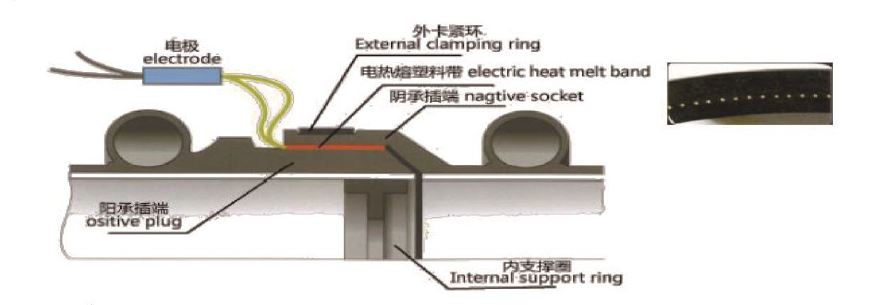
A special concept has been developed by GRTgaz Research and Innovation Center for Energy (RICE) for temperature mapping at the interface of an electrowelded assembly.The technical solution consists of a tubular piece in place of the real PE pipe, made of a non-weldable polymer with thermal parameters close to those of the PE. A series of 179 temperature sensors are integrated in this dummy pipe with an optimized arrangement which allows a thermal mapping of the interface in real time during the overall welding cycle. On the basis of the temperatures field, an “interdiffusion parameter” is calculated at each discrete location and compared to reference values attached to the different PE grades. Then it becomes possible to evaluate the weld quality beforehand in terms of design and welding conditions. Provided that some improvements and supplementary verifications are made, the technical solution as proposed can be implemented in a laboratory during qualification or batch release phases, or in the course of production monitoring. It can also be used as an expert tool for the geometrical and electrical sizing of EF fittings during their design phase.
The electrofusion (EF) technique is used worldwide for jointing of polyethylene (PE) pipes. Implemented in the rules-of-the-art, the EF technique is reliable and safe. Nevertheless and despite both its maturity and the quality system around, the field feedback reveals some divergences which need to be addressed. Such dvergences justify the implementation of complementary techniques allowing a control of some of the major parameters which govern the process, independently of the operator skills. It is now recognized that the weld quality is linked to the completion of the macromolecular interdiffusion which takes place during the welding cycle. In turn the interdiffusion process is temperature and time dependent. Consequently it is of primary importance to have a good knowledge of the way the fittings deliver the thermal energy during the welding cycle. On the basis of the interdiffusion theory, the Research and Innovation Center for Energy (RICE) has defined a minimum quality level taking into account the physicochemical parameters of the PE to be joined. For this purpose it is necessary to have at disposal the temperature profiles at the interface pipe-fitting in real time during the welding cycle. The technical solution proposed by RICE consists of a tubular piece in place of the real PE pipe, made of a non-weldable polymer with thermal parameters as close as possible to those of the PE. 179 temperature sensors are integrated in this piece with an optimized arrangement which allows a thermal mapping of the interface in real time during the overall welding cycle (heating+cooling). Then, on the basis of the temperatures field, an “interdiffusion parameter” is calculated at each discrete location and compared to reference values attached to the different PE grades. These reference values are defined beforehand by means of specific laboratory tests carried out on micro specimens, according to the original methodology designed by RICE in the early nineties. This device has been used for characterizing different 63 mm saddles and 20 mm couplers (equipping the saddle outlet).The different tests campaigns reveal some heterogeneities in the temperature fields depending on both the design of the saddle and the way the energy is delivered (electric coil arrangement, wire electrical resistivity,…). Moreover, the tests allow to evaluate the efficiency of the specified corrections of the heating time with regard to the ambient temperature ranged between -10°C and +45°C. Then the data allow an exact determination of the time at which the material has recovered the solid state after crystallization, thus giving way to a safe handling of the welded assembly by the field operator. Such a laboratory device is easy to use and reusable since it is not weldable. In addition, it guarantees a perfect and reproducible positioning of the temperature sensors with regard to the interface pipe-fitting. This device could constitute a valuable tool to check the energy delivered by a fitting either during the conception phase of the product or during the industrial production.
Artikel Source: https://www.pe100plus.com/PPCA/Laboratory-device-for-checking-the-thermal-energy-delivered-by-the-electrofusion-fittings-p1635.html
Upload by: Evi, PT Shuanglin Pipe Indonesia

 English
 Chinese (Simplified)
 Indonesian
 Japanese