by

Performance Of Buried HDPE Pipes- Part 1 : Peaking Deflection During Initial Backfilling Process

Zhou1 Y. J. Du2 F. Wang3 M. D. Liu4 PhD Candidate Professor and Director Associate Professor Senior Lecturer

Peaking deflection caused by compacting the sidefill, referred to as the maximum change of the pipe diameter divided by the undeformed diameter, is an important parameter in the design and safety check of buried pipelines. However, quantitative equations on the deflection useful for engineering practice are very limited. In this paper, a two-dimensional finite element analysis is used to investigate the peaking deflection of high-density polyethylene (HDPE) pipes. In the analyses, the pipe–soil interaction is rationally modeled. A field trial is conducted and the finite-element modeling is evaluated by using the data measured in the field test. Parametric studies are also conducted to investigate the effects of pipe diameter, pipe stiffness, soil modulus, trench width, and compactor type on the peaking deflection of buried HDPE pipes. A new estimating tool is developed that considers the major influencing factors: pipe diameter, pipe stiffness, soil modulus, and compactor type (vibratory plate or rammer) to predict the peaking deflection of HDPE pipes, and the proposed method is finally verified by data reported in published studies. The comparison of the calculated and measured peaking deflections demonstrates a reasonably good prediction of the peaking deflection.

Keywords: Geosynthetics Peaking deflection HDPE pipe Field trial FE method Empirical formula

Article Source : https://www.icevirtuallibrary.com/doi/full/10.1680/jgein.17.00009

Upload by : Evi, PT Shuanglin Pipe Indonesia
by

LONG-TERM PERFORMANCE AND LIFETIME PREDICTION OF GEOSYNTHETICS

Y.G. Hsuan1 , H. F. Schroeder2 , K. Rowe3 , W. Müller4 , J. Greenwood5 , D. Cazzuffi6 , R.M. Koerner7

To properly understand and assess the long-term behaviour of geosynthetic materials it is necessary to investigate the various types of possible degradation mechanims. This includes both chemical and mechanical behaviour, and sometimes even their interactions with one another. Clearly, chemical degradation of geosynthetics depends on the polymer type. For example, polyolefins are vulnerable to oxidation; polyesters are susceptible to hydrolysis; and plasticizers can leach from polyvinyl chloride. This paper describes the concept of these three types of degradation, but focuses on the oxidation of polyolefins since the majority of the geosynthetics is made from this type of polymer. The methods used to predict the lifetime of antioxidants and service life of the geosynthetic material will be illustrated. Furthermore, the influence of temperature, pressure, and ultraviolet light on the service life are also demonstrated. Finally, the current specifications targeting the longevity of different geosynthetics are presented. Regarding mechanical degradation, the paper mainly focuses upon the creep deformation of geogrids and stress crack resistance (SCR) of polyethylene geomembranes and geopipe. The method to assess stress crack resistance is described, and the microscopic mechanisms that lead to such failure are explained. For creep evaluation, different acceleration tests are presented and their applicability with respect to the different types of polymers is illustrated. In addition, the long-term shear behaviour of geocomposites and geosynthetic clay liners is presented

Over the past fifteen years, a significant effort has been made to understand the various degradation mechanisms that are relevant to the geosynthetics. Appropriate laboratory tests have been developed to evaluate the long-term quality of the products. Also a few generic specifications have been established at the regional or international levels to ensure product standards meet these durability criteria. Perhaps the next phase of the durability research should be to generate data from field-retrieved samples. Geosynthetics have been used for approximately 30 years. Characterizing existing field samples would be useful to confirm the aging process predicted from laboratory acceleration tests. Contrary, it would not be beneficial to characterize a field-retrieved geosynthetic sample in terms of life prediction of new products, if the formulation has been changed or improved. The improvement in resins, and particularly in additive packages, has been meaningful and it is entirely possible that the current generation of geosynthetic products will have far greater durability than older resins and additive packages. Selecting the appropriate laboratory acceleration tests is essential to ascertain the long-term behaviour of these new products.

article source: https://www.researchgate.net/publication/237707637_LONG-TERM_PERFORMANCE_AND_LIFETIME_PREDICTION_OF_GEOSYNTHETICS
Upload by Evi, PT Shuanglin Pipe Indonesia

by

Durability of Polyethylene Geopipes for Landfill Applications After Several Years in Service

Durability of polyethylene geopipes for landfill applications after several years in service

Helmut Zanzinger, Kurt Engelsing & Sebastian Hausmann SKZ – German Plastics Center, Würzburg, Germany

Geosynthetics (GSY) and geopipes (GPI) used for landfill applications should have a guaranteed service life of at least 100 years according to the up-to-date landfill directive in Germany. Bearing in mind the high permanent temperatures in landfills, GPIs and GSYs have to have an excellent long-term stability. Almost all GPIs installed in landfills are made of polyethylene (PE). The most common reasons for failure of polyolefins are oxidation, stress cracking and leaching. For this study, GPIs have been taken from three different landfill sites after up to 20 years in service at approximately 40 °C and tested in the laboratory. For comparison, two state-of-the-art PE-samples (PE80 and PE100) were tested too. A High Pressure Autoclave Test (HPAT) was used to determine thermo-oxidative and leaching behaviour. Stress crack resistance was determined by Full Notch Creep Test (FNCT) and Strain Hardening Method. The laboratory tests revealed that after only approx. a fifth of the required minimum service life of 100 years, material properties of some samples are by far worse than the requirements for new products. The test results show that a service life of at least 100 years can most likely not be fulfilled by many products, which however did meet the requirements for GPIs for landfill applications in state as delivered, described 20 years ago.

Article source : https://www.researchgate.net/publication/289577961_Durability_of_polyethylene_geopipes_for_landfill_applications_after_several_years_in_service
Upload by : Evi, PT Shuanglin Pipe Indonesia

by

Case study – Clogging of a geotextile/geopipe system in a landfill drainage application.

Fleming, I.R. & Barone, F.S. & Dewaele, Paul. (2010).

9th International Conference on Geosynthetics – Geosynthetics: Advanced Solutions for a Challenging World, ICG 2010. 1127-1130. In 2004, a drainage system was installed near the toe of a municipal landfill serving the city of Barrie, Ontario. The drainage system consists of 300 mm diameter perforated HDPE pipe and is intended to prevent leachate-contaminated groundwater from reaching a small stream via seepage through the surficial sand deposits which dominate the local area. The double-walled pipe is constructed with smooth inside walls and corrugated outside walls, wrapped with a lightweight heat-bonded nonwoven geotextile. The perforated pipe was installed 3 to 5 m below ground surface within fine aggregate (concrete sand) backfill placed in the trench excavated below the water table into the native sands. In 2007, visual evidence of leachate impact to the stream led to an investigation. This investigation included video inspection of the inside of the drain, measurement of hydraulic heads in the immediate vicinity, and an exhumation and sampling of the drainage system at three locations. Samples of the drainage pipe and the geotextile wrapping were tested for permeability and the nature of the mineral clogging was evaluated. Laboratory testing showed the permeability of the geotextile had decreased by 50X on average. The channels of the geopipe were largely full of clog material and many of the perforations were completely blocked. This paper presents the results of the investigation and compares the unclogged and clogged hydraulic conductivity of the geotextile and the sand backfill. The performance of the drainage ribs in the corrugated geopipe is evaluated and the factors influencing the selection of design components of the replacement system are discussed.

Article Source by https://www.researchgate.net/publication/287029328_Case_study_-_Clogging_of_a_geotextilegeopipe_system_in_a_landfill_drainage_application
Upload by Evi, PT Shuanglin Pipe Indonesia

by

HDPE-Geopipes, Soil-Structure Interaction

Zanzinger
LGA, Geotechnical Institute, Nuremberg, Germany
Gartung
LGA, Geotechnical Institute, Nuremberg, Germany

Perforated geopipes are part of the leachate collection system at the base of solid waste landfills. Their structural performance depends on the embedment which is formed by a compacted clay layer, a geomembrane and a sand-bentonite cushion below and coarse gravel above the pipe. Two large scale model tests were earned out. A, big geopipe-basal liner model was submitted to uniformly spread static loads up to 1200  kPa. The deformations of the 300mm diameter pipes were measured by a mobile laser device and by strain gauges applied at the surfaces of the pipes. Earth pressure cells and extensometers recorded the deformation pattern and the load distribution within the soil layers surrounding the pipes. The evaluation of the data reveals a clear picture of the soil-structure interaction of the HDPE geopipes at the base of high landfills. The test results facilitate the calibration of analytical and numerical methods of structural analysis.

Source : https://www.researchgate.net/publication/297731276_HDPE-Geopipe_Soil-Structure_Interaction

Upload by Evi, PT Shuanglin Pipe Indonesia

by

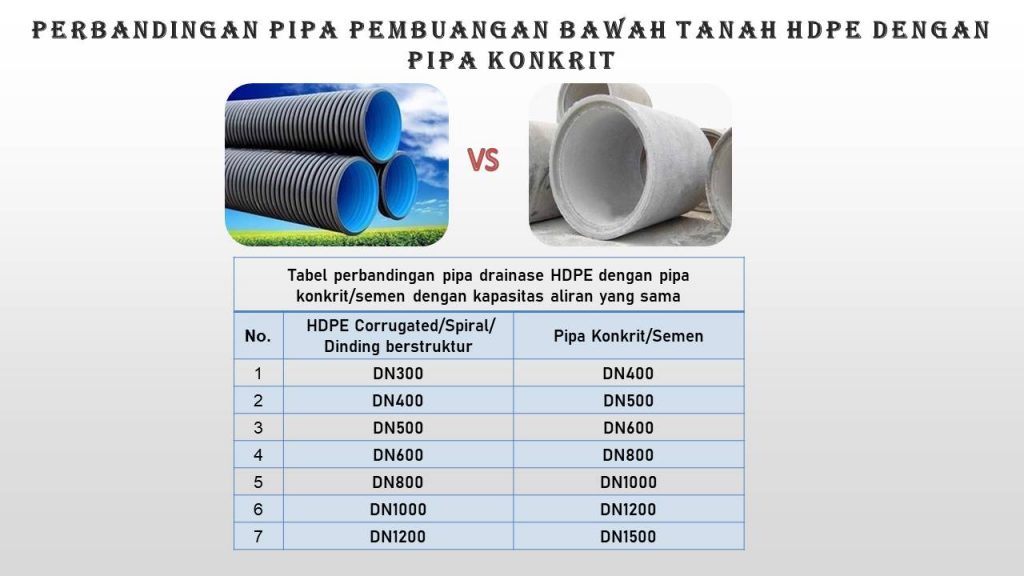
Perbandingan pipa pembuangan bawah tanah HDPE dengan pipa konkrit

1.Diameter pipa antara DN600-DN1600, rasio harga satuan komprehensif dengan diameter yang sama antara pipa HDPE dengan pipa konkrit/semen adalah 1:1.3.
2.Kapasitas aliran HDPE 1.3 kali dari pipa konkrit/semen. Misalnya jika menggunakan pipa konkrit/semen diameter DN800, maka pipa HDPE hanya perlu menggunakan diameter DN700(800/1.3).
3.Penyambungan HDPE yang sederhana dan cepat, meningkatkan kemajuan konstruksi. Dalam kondisi normal, hanya membutuhkan 30% dari waktu konstruksi pipa konkrit/semen sehingga menghemat biaya konstruksi.
4.Standar panjang pipa HDPE adalah 6 meter, semuanya diproduksi menggunakan bahan baku HDPE, ringan sehingga menurunkan penggunaan peralatan mekanis.
5.Koefisien kemiringan pipa HDPE dan area kerja kecil, penyambungan pipa dapat dilakukan di atas tanah, sehingga penggalian parit dapat dikurangi lebih dari 30% dan sangat menghemat biaya teknis.
6.Pipa HDPE dapat beradaptasi dengan struktur tanah yang tidak rata seperti pondasi lunak, dan alur/parit pipa tidak memerlukan pondasi dasar.
7.Masa pemakaian pipa HDPE lebih dari 50 tahun, masa pemakaian sistem pipa juga lebih dari 50 tahun, 2.5 kali lipat dari masa pemakaian pipa konkrit secara teori, pada dasarnya merupakan keuntungan jangka panjang dalam sekali berinvestasi.

Source : PT Shuanglin Pipe Indonesia
Upload by Evi, PT Shuanglin Pipe Indonesia

Switch The Language
    × Contact Us!

    PT SHUANGLIN PIPE INDONESIA is a joint venture subsidiary of Zhejiang Shuanglin Environment Co., Ltd. Our factory is located in CIKARANG, Indonesia. The plant covers an area of 4,000 square meters. Our company has introduced advanced production line and a professional production management team. The company mainly produces municipal and residential building water supply and drainage, sewage pipes and complete sets of systems. The product line includes HDPE/PP double-wall corrugated pipe and inspection wells for pipeline connection and other accessories.

    ADDRESS

    KAWASAN INDUSTRI DELTA SILICON 5 JL.KENARI BLOCK G.1 NO.28A-B LIPPO CIKARANG CIBATU CIKARANG SELATAN KAB BEKASI JAWA BARAT

    ADDRESS

    PT SHUANGLIN PIPE INDONESIA
    (NEW PLANT KITIC)
    Jl. Anggrek VII, Kavling No.26 Kawasan Industri Terpadu Indonesia China (KITIC ) Deltamas, Desa Nagasari. Kec. Serang Baru. Kabupaten Bekasi. Jawa Barat 17330

    PHONE

    (021) 89915151

    EMAIL

    info@shuanglinpipe.co.id