by

RESTRAINED MECHANICAL JOINING DEVICES FOR HDPE PIPE: PERFORMANCE CHARACTERISTICS AND TEST PROTOCOL

Justin Brandt, Mike Griffin, Tony Cuvo

# 2021 Amsterdam

As plastic pipe gains share in new markets and applications, additional joining methods add further value, enabling continued growth for plastic pipes. To date, definitions of a “fit-for-purpose” mechanical joint for High Density Polyethylene (HDPE) pressure piping systems can vary significantly. As such, mechanical joints are typically undifferentiated from each other even though different manufacturers offer a range of products that provide a wide range of pressure capability and restraint perform ance. This presentation will lay out the industry standards used to define test protocols for determining the performance of a self-restrained mechanical joint for HDPE pressure pipe. This will provide a better appreciation of how self-restrained mechanical joints perform relative to what is commonly practiced in the industry. This presentation will also highlight the differences between various categories of mechanical joints to further educate the audience on restrained joint performance versus unrestrained joint performance. Further evaluation was conducted to explore mechanical joint performance relative to incumbent joining solutions: butt fusion and electrofusion. The audience will come away with a deeper appreciation of the technology behind restrained mechanical joining devices within the plastics market, how they can be misunderstood and why they are integral in the continued growth of this industry.

https://www.pe100plus.com/PPCA/RESTRAINED-MECHANICAL-JOINING-DEVICES-FOR-HDPE-PIPE-PERFORMANCE-CHARACTERISTICS-AND-TEST-PROTOCOL-p1783.html

by

THE ADVANTAGES OF PE 100 GLOBAL CASE STUDIES

Youssef Taha, Rainer Kloth

# 2021 Amsterdam

In the early fifties, the first Polyethylene for the use in pipes was produced. Since then, the use of Polyethylene piping systems has spread rapidly around the globe to serve in various applications. In order to demonstrate the versatility and benefits of PE100, several companies founded in 1999 an association specially focusing on these grades. Starting with three core companies in Europe the association is now proud to be supported by 14 member companies scattered around the world. Showing the advantages of PE 100 regarding safe installation, operation and keeping high quality of materials are the major tasks of the organization. Today PE 100 is increasingly replacing traditional materials and the following case studies document the trust the industry and the users have put into PE 100.


https://www.pe100plus.com/PPCA/THE-ADVANTAGES-OF-PE-100-GLOBAL-CASE-STUDIES-p1794.html

by

Sustainability is achieved through less time for excavation, less handling of soil excavated from trench, less hauling of materials (both to and from construction sites), and reuse and recycling. This all means less energy consumption: In many cases, thes

Amster Howard

# 2021 Amsterdam

Deeper pipe burial, less expensive and environmentally friendly backfill, uniform language for contractors and inspectors, simplified installations for smaller pipe, and allowable construction in poor soil conditions are highlights in the latest edition of AWWA M55 and all benefit the users of HDPE pressure pipe. This paper summarizes the significant updates to the design and installation recommendations in the Second Edition of AWWA (American Water Works Association) Manual M55 PE Pipe – Design and Installation to be published in 2020. For design, these updates include higher Eʹ (Modulus of Soil Reaction) values, use of composite Eʹ values, use of Uniform Soil Classes, use of geotextiles, and terminology. For installation, there is revised information on trench width, flowable fill, inspection and soil testing, and compaction requirements. These changes reflect the recent revisions to ASTM D2774 Standard Practice for Underground Installation of Thermoplastic Pressure Piping. The changes are applicable to all pipe diameters and to all pipe stiffness values. The Second Edition of M55 encourages the use of basic installation and engineered installation for buried pressure PE pipe. The basic installation is for HDPE pipe stiff enough to not need special bedding and embedment, for shallow burial with no live load, and for stable trench wall support. In this case, the HDPE pipe can be laid on the trench bottom and backfilled with compacted soil from the excavation. This covers the majority of HDPE pressure pipe installations. For other conditions, the engineered installation means selecting an HDPE pipe and corresponding installation details to meet deflection, compressive strength, and buckling requirements. The engineered installation approachrecommends an uncompacted bedding and an uncompacted padding zone over the top of the pipe.

https://www.pe100plus.com/PPCA/Sustainability-is-achieved-through-less-time-for-excavation-less-handling-of-soil-excavated-from-trench-less-hauling-of-materials-both-to-and-from-construction-sites-and-reuse-and-recycling-This-all-means-less-energy-consumption-In-many-cases-thes-p1732.html

by

HISTORY OF HDPE USE AT THE CITY OF PALO ALTO FOR POTABLE WATER DISTRIBUTION

Greg Scoby, PE

# 2021 Amsterdam

This paper will detail the steps taken during adoption of HDPE for potable water systems improvements including material justification, creation of related specifications, investigation of available piping components, qualification of contractors and the construction/inspection of related systems.

The City of Palo Alto, California, USA adopted HDPE as the primary material for water distribution in 2010. This adoption was implemented in an accelerated water main replacement program initiated in 1994. The accelerated infrastructure program lowered the level of replacement from 233 years to 77.6 years which is well within the anticipated useful life of HDPE materials (100 years minimum). This paper provides a historical account of the City’s Utilities Department along with statistics of the systems composition. Several construction projects involving the exclusive use of HDPE are included.

Approximately 10 years ago, the City of Palo Alto made the decision to convert to HDPE for potable water distribution. This decision was based on the experience gained with the exclusive use of polyethylene for natural gas distribution made in the late 1980s. Several factors were considered to support this conversion. The major driving force was the leak free performance of a monolithic self-restraining system provided by fused connections. Other factors guiding this decision included the projected life of the material, minimizing corrosion failure associated with buried metallic components, ability to install piping with trenchless construction methods to minimize installed cost and customer inconvenience and the need to construct a resilient distribution system capable of remaining in service during and after seismic events. The San Andreas Fault traverses Palo Alto. In the early 1990s, utility department staff convinced Council members of the need to increase replacement levels associated with the water, gas and wastewater systems. An accelerated infrastructure replacement program was funded and additional engineering staff hired to focus on the design and construction of all three mentioned systems. In 2009, staff started the revisions of the existing standards Copyright © 2021 by (Greg Scoby, PE, Crossbore Consultants, Gregs@CrossboreConsultants.com)and construction documents for the water system and joined the Plastics Pipe Institute Municipal Advisory Board and the American Water Works 263 Polyolefin Committee (responsible for polyethylene standards) to ensure the newly created HDPE specifications represented the best practices.

Staff utilized past experience gained during natural gas projects to implement the use of trenchless construction methods for potable water system replacement. The first HDPE project, Water Main Replacement 21/22, was constructed over the 2010/2011 fiscal year with main sizes ranging from 8 inch (200 mm) through 16 inch (400 mm) encompassing a total 31,680 linear feet (9.7 km) of mains. Construction was performed by a polyethylene qualified contractor utilizing both trenchless and open cut construction methods. Based on the success of this project, full adoption of HDPE for water, including mains and services, was made for all system extensions and improvements/replacements. HDPE is currently the primary material specified by the City for potable water distribution.

https://www.pe100plus.com/PPCA/HISTORY-OF-HDPE-USE-AT-THE-CITY-OF-PALO-ALTO-FOR-POTABLE-WATER-DISTRIBUTION-p1792.html

Switch The Language
    × Contact Us!

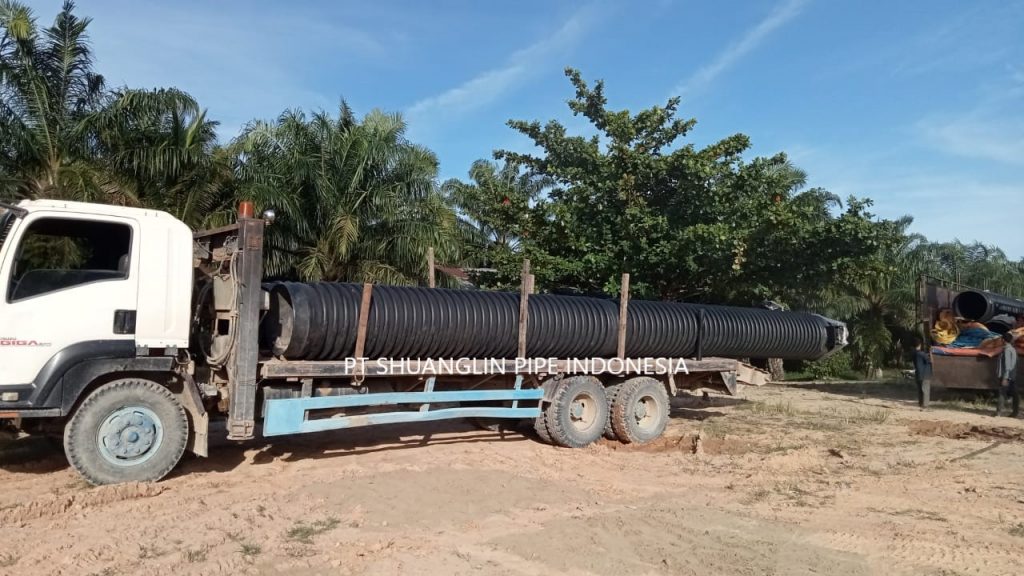
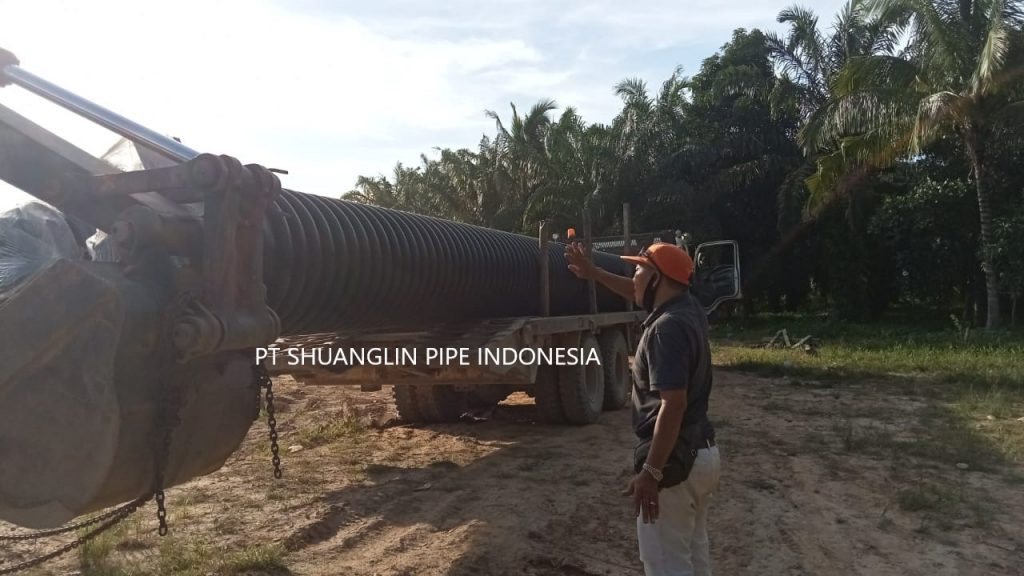
    PT SHUANGLIN PIPE INDONESIA is a joint venture subsidiary of Zhejiang Shuanglin Environment Co., Ltd. Our factory is located in CIKARANG, Indonesia. The plant covers an area of 4,000 square meters. Our company has introduced advanced production line and a professional production management team. The company mainly produces municipal and residential building water supply and drainage, sewage pipes and complete sets of systems. The product line includes HDPE/PP double-wall corrugated pipe and inspection wells for pipeline connection and other accessories.

    ADDRESS

    KAWASAN INDUSTRI DELTA SILICON 5 JL.KENARI BLOCK G.1 NO.28A-B LIPPO CIKARANG CIBATU CIKARANG SELATAN KAB BEKASI JAWA BARAT

    ADDRESS

    PT SHUANGLIN PIPE INDONESIA
    (NEW PLANT KITIC)
    Jl. Anggrek VII, Kavling No.26 Kawasan Industri Terpadu Indonesia China (KITIC ) Deltamas, Desa Nagasari. Kec. Serang Baru. Kabupaten Bekasi. Jawa Barat 17330

    PHONE

    (021) 89915151

    EMAIL

    info@shuanglinpipe.co.id