by

Testing methods : Strength and resistance

Creep rupture strength – Internal pressure test

Constant internal pressure at constant temperature

The internal pressure test is standardised in ISO 1167 and EN 921 “Thermoplastic pipes for the conveyance of fluids – Resistance to internal pressure – Test method”. The test specifies a method for determination of the resistance to constant internal pressure at constant temperature. The test samples are kept in an environment at a specific constant temperature, which can be either water (“water-in-water” test), another liquid (“water-in-liquid”) or air (“water-in-air” test). The tests for the PE100+ Association are performed on 110 mm SDR 11 pipes as “water-in-water” test. In terms of lengths of the pipe, the standard requires at least three times the outside diameter. For pipes bigger that 315 mm outer diameter, a minimum length 1.000 mm shall be used.
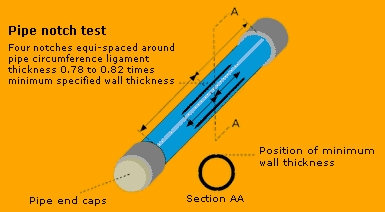
Stress crack resistance - Pipe notch test

Stress crack resistance – Pipe notch test

Slow crack growth testing

The Pipe notch test is standardised in ISO 13479 “Polyolefin pipes for the conveyance of fluids – Determination of resistance to crack propagation – Test method for slow crack growth on notched pipes (notch test)”. The test simulates slow crack growth and record time to failure on notched pipes. The testing environment accords to ISO 1167 and EN 921 in terms of temperature and specified constant internal pressure. PE pipes are tested at 80ºC under certain pressure levels, depending on the SDR (Standard Dimension Ratio). All tests for the PE100+ Association are carried out on 110 mm SDR 11 pipes, which leads to an internal test pressure of 9.20 bar.
The CEN/ISO standard refers to a testing time of =165h at 80C at 9.20 bar for PE 100 materials.
The PE100+ Associations requirement is enlarged by three times up to =500h using the same testing conditions.

Resistance to Rapid Crack Propagation – S4 Test

RCP phenomenon simulation in plastic pipes

The small-scale steady-state test (S4 test) is standardised in ISO 13477 “Thermoplastics pipes for the conveyance of fluids – Determination of resistance to rapid crack propagation (RCP).” The test simulates the phenomenon of RCP in plastic pipes and measure the determination of arrest or propagation of an initiated crack. In pipelines RCP, caused by a brittle crack, could undergo the length of several hundred meters almost at the sound of speed.

This requires even more awareness about RCP. The current EN/ISO standards provide a maximum of 10 bar for natural gas and 25 bar for potable water pipelines as operating pressure. The determination of the required testing pressure is based on the MOP (maximum operation pressure) and would result in a testing pressure of only 4.2 bar for a MOP of 10 bar.

The PE100+ Association takes that into consideration and raises it’s requirement in terms of the testing pressure in the S4 test up to minimum 10 bars. Straight test pipe samples are used with square ends with a specified length of seven times external diameter of the pipe. All tests within the PE100+ Association are specified with 110 mm SDR 11 pipes with 800 mm length.

The test is carried out by a conditioning temperature of 0C using nitrogen or air to pressurise up the pipe. The pipes are prepared with leaktight endcaps, which are fitted over each end.

The test apparatus is designed to simulate a fast-running longitudinal crack following a small notch inside the pipe.

The energy obtained during an impact on a pipe sample, caused by a falling weight including a striker blade, might assure a fast running crack if the resistance to RCP is below a certain level.

The required crack arrest is defined, when the crack does not exceeds or equal 4.7 times the outer diameter of the pipe. Research work to determine the correlation factor between of the S4 and the full-scale test is ongoing.

The CEN/ISO standard requires a critical pressure Pc,S4 with the displayed formula above at a testing temperature of 0C.
The PE100+ Association takes that into consideration and raises it’s requirement in terms of the testing pressure in the S4 test up to minimum 10 bars.
Creep rupture strength - Internal pressure test

Creep rupture strength – Internal pressure test

Resistance to internal pressure

The internal pressure test is standardised in ISO 1167 and prEN 921 ”Thermoplastic pipes for the conveyance of fluids” – Resistance to internal pressure – Test method. The test specifies a method for determination of the resistance to constant internal pressure at constant temperature. The test samples are kept in an environment at a specific constant temperature, which can be either water (”water-in-water” test), another liquid (”water-in-liquid”) or air (”water-in-air” test). The tests for

Article Source : https://www.pe100plus.com/PE-Pipes/materials/Testing-methods/Testing-methods-i237.html

Upload by Evi PT Shuanglin Pipe Indonesia

by

The Impact of Heavy Hydrocarbon Permeation on PE Pipe

Karen Crippen, Ernest Lever
Papers # 2014 Chicago

DOT/PHMSA held a Government/Industry Pipeline R&D Forum on July 18-19, 2012. Five working groups met to discuss key pipeline technical challenges facing industry and government. The Design/Materials/Welding-Joining & Valves working group identified the effects of hydrocarbon permeation on plastic pipe strength and fusion performance as a gap that needs to be addressed. There is mounting evidence in certain regions that PE gas distribution pipelines are being exposed to hydrocarbon contamination. Because PE is nonpolar, it is a very poor barrier to nonpolar hydrocarbons as might be found in the natural gas industry. In the case of liquid permeation, the diffusion phenomenon occurs in areas of gross contamination when liquid hydrocarbon condensates form in gas pipelines, or when soil surrounding the pipe is heavily contaminated with liquid hydrocarbons (diesel, gasoline, etc.). The presence of these hydrocarbons in the plastic matrix can have a negative influence on two important aspects associated with gas operations: thermal fusion quality and pipe strength. The magnitude of the impact depends on the amount of contamination. The most common issue is that heat joining techniques on hydrocarbon permeated pipes may result in lower strength joints. Because the source of contamination can be both internal and external, it can affect any type of saddle and butt fusions. If the pipe wall is weakened, it may require derating. Also of interest is the impact of impregnated hydrocarbons on slow crack growth (SCG). It is not understood whether the presence of hydrocarbons inhibits or accelerates SCG. This paper will provide an update on the status of the two year research project that GTI has undertaken to quantify the effects of hydrocarbon contamination on PE pipe. Current results will be presented and discussed at the conference presentation.


Article source : https://www.pe100plus.com/PPCA/The-Impact-of-Heavy-Hydrocarbon-Permeation-on-PE-Pipe-p1391.html

Upload by:  Evi, PT Shuanglin Pipe Indonesia 

by

Investigation of The Failure Behavior of Polyethylene Electrofusion Sockets

Isabelle J. Berger, Andreas Frank, Gerald Pinter, David Nitsche, Dirk Petry

Papers # 2018 Las-Vegas

Electrofusion (EF) sockets constitute a well-established and practically proven technology for the joining of polyethylene (PE) pressure pipes. As for the pipes, the potential lifetime of such welding connections is beside other properties also depending on the resistance against slow crack growth (SCG). The current paper presents a scientific approach for a fracture mechanics lifetime prediction based on quasi-brittle failure behavior of EF sockets made of polyethylene. Therefore, various internal pressure tests on EF sockets were conducted under elevated test conditions with focus on generating quasi-brittle failure curves and investigating characteristics of crack initiation and SCG. In combination with internal pressure tests, a numerical simulation (FEM) model for the stress intensity factor characteristics in EF sockets was created to predict the time to brittle failure. The results demonstrate that with the fracture mechanics approach a reliable prediction of minimum lifetimes of EF sockets for internal pressure loading situations and application oriented installation situations is possible.

Articles Source : https://www.pe100plus.com/PPCA/Investigation-of-the-failure-behavior-of-polyethylene-electrofusion-sockets-p1699.html

Upload by : Evi, PT Shuanglin Pipe Indonesia

by

Less is more: polypropylene materials for sewerage & drainage pipes with reduced energy and carbon footprints

Papers # 2016 Berlin

The environmental impact in terms of global warming potentials (GWP) and nonrenewable energy demand (NRED) of sewerage & drainage pipes based on PP-MD, PP-HM, PP-B, and concrete has been assessed using life cycle analysis methodology. It can be concluded that PP-MD and PP-HM materials are able to significantly lower both GWP and NRED of PP S&D pipes. Moreover, PP-MD has been found to provide the lowest GWP of all pipe materials investigated, whilst approaching concrete as the material with the lowest NRED.

Driven by a growing global conscience about our influence on the planet’s current and future climate and the scarcity of resources to satisfy a growing global population, product design that takes into account the product’s impact on both these factors is becoming increasingly important. In this paper a life cycle analysis is presented that looks specifically at two recently developed PP materials for S&D pipes, PP-MD and PPHM, that have been designed to lower the energy and carbon footprint of the resulting pipes. The LCA focuses on plain wall S&D pipes with a minimum ring stiffness SN >8 kN/m² and pipe diameters between 110 and 800 mm. The NRED and GWP of these new PP materials is compared to pipes based on conventional PP-B and concrete. It was found that PP-MD is able to provide the lowest GWP of all materials investigated and the lowest NRED of all plastic materials. PP-HM is able to lower the GWP and NRED compared to PP-B by 7 and 9%, respectively. Comparison of the results from this study to existing LCA’s on PP-B and concrete pipes, demonstrates a very good agreement thus underlining its accuracy and significance.

Article Source : https://www.pe100plus.com/PPCA/Less-is-more-polypropylene-materials-for-sewerage-drainage-pipes-with-reduced-energy-and-carbon-footprints-p1522.html
Upload by : Evi, PT Shuanglin Pipe Indonesia

by

Long-Term Behavior Of Glass Fiber Reinforced Polyethylene

Mitsuaki Tokiyoshi, Philippe Vanspeybroeck, Kensei Inoue, Stephan Fullgrabe, Takashi Kuriyama, Toshinori Kawabata, Joji Hinobayashi

Papers # 2016 Berlin

Big diameter polyethylene pipes used an important role due to superior performance (Flexibility, light weight, long lifetime and tighten joint) for water and industrial supply to several countries. However according to standard concerned Polyethylene pipes as like ISO4427 we are being used solid wall pipe with too wall thickness against for internal pressure. The major job challenge involved finding new polyethylene solution with best high modulus and flexibility such as superior performance of polyethylene for world customers.

In achieving this, polyethylene resin with glass fiber named PE-GF by spiral cross winding method take us new. Our technical team should be considered a several resolution not only short term test but also long-term behavior of this Glass fiber reinforced polyethylene pipes.

This paper focuses on long term evaluation test for pipes and fittings. At first, explores will get results RCP (S4) test for pipes. Also explores estimated welding factor for Butt welding joint.

Articles Source : https://www.pe100plus.com/PPCA/Long-term-behavior-of-glass-fiber-reinforced-polyethylene-p1528.html
Upload by : Evi, PT Shuanglin Pipe Indonesia

by

Production of Potable Water Pipes for Chile Using the Inline Extrusion Process

Douglas D. Keller

Papers # 2018 Las-Vegas

This paper describes the successful collaboration of a regulator, pipe producer and PE material supplier to demonstrate the conformance of pipes produced with inline extrusion compound to the requirement of the Chilean water pipe normative NCh398/1.Of2004 and also to the performance requirements of ISO 4427:2007 parts 1, 2 & 5. The study also highlights the need to carefully consider the design of the system that combines natural compound plus coloring master batch as well as the extruder and screw design in order to properly disperse the carbon black (or any other pigment) into the natural compound during inline extrusion.

Cooperation between the regulator, Centro de Estudios de Medición y Certificación de calidad (CESMEC), pipe producers and a PE material supplier has contributed to Chile’s allowance for the use of natural compound plus black masterbatch for the inline extrusion compound for the production of potable water pipes. An inline extrusion process involves the blending of natural (unpigmented) pellets and black masterbatch pellets, at a specified ratio, where the melt blending of the two components occurs in the extruder producing the pipe. In a 2011 meeting between the regulator and seven pipe producers in Chile, it was communicated that the inline extrusion process would be allowed if test data confirmed that pipe made from this process met the requirements of the Chilean normative NCh398/1.Of2004.

This paper discusses the cooperation between the regulator, pipe producers and a polyethylene material supplier to manufacture inline extruded pipe and demonstrate the ability of two different formulations of natural compound plus black masterbatch to meet the material and pipe properties of NCh398/1. Data demonstrating performance of the inline extrusion produced pipes will be provided as well as a comparison of acceptable and unacceptable methods for blending the natural and black masterbatch pellets prior to inline extrusion production of pipes.

Article Source : https://www.pe100plus.com/PPCA/Production-of-Potable-Water-Pipes-for-Chile-Using-the-Inline-Extrusion-Process-p1671.html
Upload by : Evi, PT Shuanglin Pipe Indonesia

Switch The Language
    × Contact Us!

    PT SHUANGLIN PIPE INDONESIA is a joint venture subsidiary of Zhejiang Shuanglin Environment Co., Ltd. Our factory is located in CIKARANG, Indonesia. The plant covers an area of 4,000 square meters. Our company has introduced advanced production line and a professional production management team. The company mainly produces municipal and residential building water supply and drainage, sewage pipes and complete sets of systems. The product line includes HDPE/PP double-wall corrugated pipe and inspection wells for pipeline connection and other accessories.

    ADDRESS

    KAWASAN INDUSTRI DELTA SILICON 5 JL.KENARI BLOCK G.1 NO.28A-B LIPPO CIKARANG CIBATU CIKARANG SELATAN KAB BEKASI JAWA BARAT

    ADDRESS

    PT SHUANGLIN PIPE INDONESIA
    (NEW PLANT KITIC)
    Jl. Anggrek VII, Kavling No.26 Kawasan Industri Terpadu Indonesia China (KITIC ) Deltamas, Desa Nagasari. Kec. Serang Baru. Kabupaten Bekasi. Jawa Barat 17330

    PHONE

    (021) 89915151

    EMAIL

    info@shuanglinpipe.co.id